I once thought painting an accent wall would be the artistic adventure of a lifetime. Spoiler alert: it was more like a comedy of errors. Picture this—a half-painted wall that looked less like a stylish accent and more like a crime scene. My attempt at a geometric masterpiece ended up resembling a toddler’s doodle session. The kind of thing that makes you question all your life choices. And let’s not even talk about the paint spills that had my living room looking like a Jackson Pollock reject.
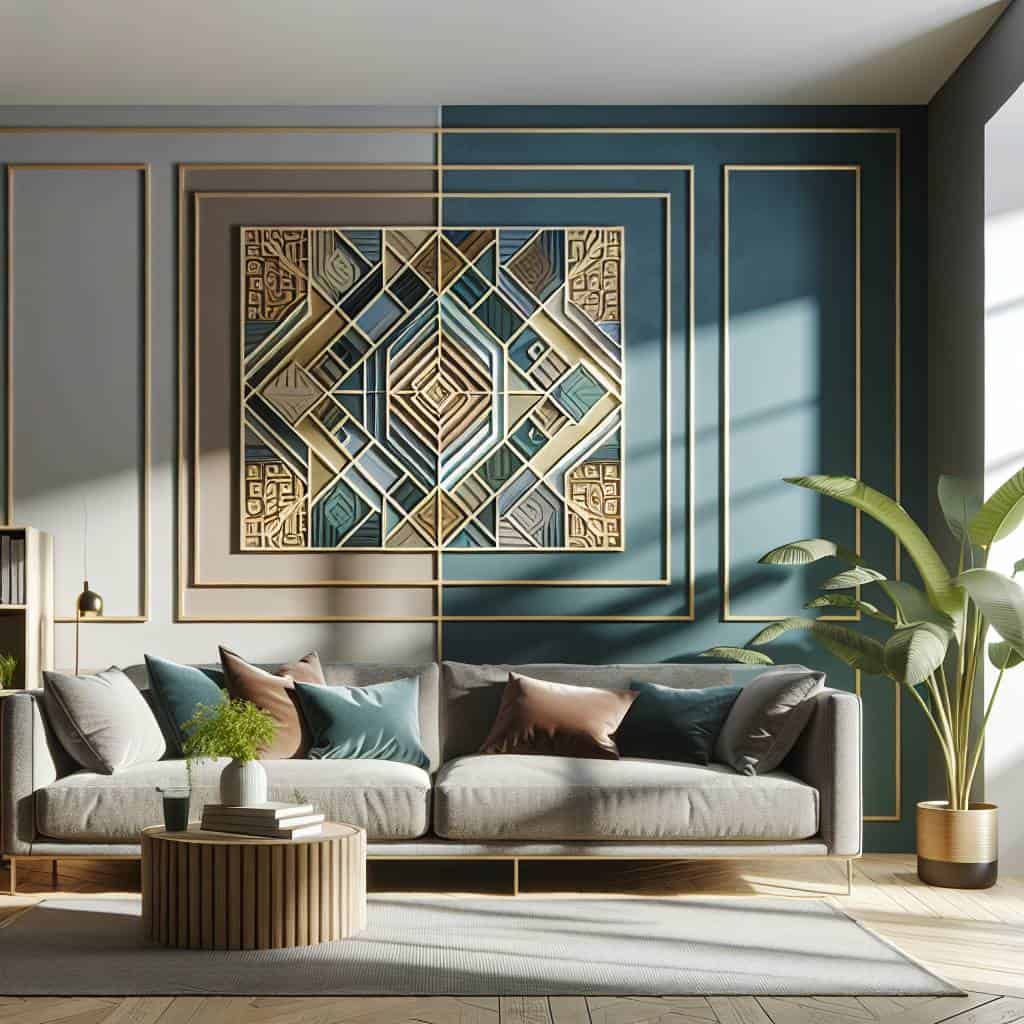
But hey, I survived to tell the tale and save you from the same fate. This article is your roadmap through the chaos of accent wall painting techniques. We’ll dive into the good, the bad, and the downright ugly of geometric designs, ombré fades, and stencil disasters. No sugar-coating. Just real talk on how to avoid the pitfalls and maybe, just maybe, end up with a wall that doesn’t make you cringe every time you walk by.
Table of Contents
The Day I Got Lost in a Maze of Geometric Shapes
I remember the day vividly. There I was, armed with painter’s tape, stencils, and an overinflated sense of confidence, ready to tackle the accent wall of my living room. The plan? A mesmerizing maze of geometric shapes, a testament to my DIY prowess. What could possibly go wrong? Well, as it turns out, a lot. You see, when you’re knee-deep in triangles, hexagons, and whatever other shapes I foolishly thought I could conquer, reality hits you like a bucket of cold paint. It’s one thing to envision a chic, modern masterpiece; it’s another to find yourself in a chaotic tangle where every line seems just a millimeter off.
But let’s get real—if you’re expecting a Pinterest-perfect outcome, you’re setting yourself up for a hard fall. The truth is, painting an accent wall with geometric shapes is enough to test anyone’s patience, let alone someone like me, who barely managed to pass high school geometry. It’s not just about slapping paint on the wall and calling it a day. Each shape competes for attention, and if your angles aren’t sharp enough, you’ll end up with a design that looks like your toddler found the paintbrush. And don’t even get me started on the ombré effect I ambitiously tried to incorporate. Picture a gradient that’s more ‘muddy waters’ than ‘serene sunset’. Yet, amidst the chaos, there’s something liberating. You learn to embrace the imperfections—because, in the end, that’s what makes the wall yours. It’s a reflection of sweat, maybe a few tears, and a whole lot of character.
The Accidental Artist’s Reckoning
Here’s the thing about diving into the world of accent walls with all these so-called ‘techniques’. It’s a bit like trying to run a marathon after binge-watching a fitness series. You get the gist, but when you lace up your shoes, reality hits hard. Geometric shapes? They sound edgy until they morph into some chaotic puzzle on your living room wall. And don’t get me started on ombré—it’s like a bad Instagram filter you can’t swipe away.
But in the end, maybe that’s the beauty of it. The imperfections, the mismatched lines, the colors that seemed perfect in theory but missed the mark in practice. They’re reminders that life isn’t a neat, polished Instagram reel. It’s messy, it’s unpredictable, and sometimes it’s downright ugly. But it’s real. So, maybe my wall looks more like a toddler’s crayon experiment than a Pinterest masterpiece. But it’s mine. And I’d take a wall full of honest mistakes over a sterile, perfect backdrop any day. Let the critics judge. We’re here to live, not to impress.